Most breeders end up bottle or tube feeding at some point. Sometimes it's a true orphan — the dam died whelping or refused the litter. More often the dam is alive and present but can't nurse: she is groggy from a C-section for the first 6–12 hours, recovering from mastitis or eclampsia, her milk hasn't come in (agalactia), or a large litter keeps pushing one or two puppies off the nipple.
In every one of those cases the technique is the same: a warm puppy, warm formula, belly-down position, the right interval, and post-feed stimulation. The timeline is brutal — a feed every two hours, around the clock, for the first week of life. The technique is learnable.
The mistakes — wrong position, cold formula, a cold puppy, a missed stimulation — kill puppies fast. This guide walks through all of it: bottle vs tube, what formula to use, how to position, how often, how much, how to stimulate elimination, and the red flags that mean stop and call the vet.
The short version
- Warm first, then every 2 hours: A puppy must be warm and stable before any feed. In week 1 that feed comes every 2 hours, round the clock — 12 a day.
- Belly-down, head neutral, never on the back: Feed the puppy in the position it would nurse in. Back-feeding pools formula toward the airway.
- Formula at 100°F (38°C): Warmed in a bowl of warm water and tested on your wrist — never microwaved.
- Weigh every day: A loss, or no gain, on any day after the first 24 hours is a same-day vet call. A dip of up to 10% on day one is acceptable only in a warm, feeding puppy — more than 10% is a vet call too.
- Stimulate after every feed: A warm, wet cotton ball on the genital area, every feed, until you see the puppy pee and poop on its own — about 3 weeks.
Bottle if the puppy can suckle, tube if it can't
Bottle feeding is the default when a puppy can suckle. Tube feeding is required when it can't — either physically (cleft palate, severe weakness) or because the puppy is too compromised to take enough volume by bottle to survive the feeding interval. Use this decision framework:
| Situation | Bottle | Tube |
|---|---|---|
| Puppy has a strong, rhythmic suckle on your finger | Yes | No |
| Puppy is alert, warm, and can hold its head up | Yes | No |
| Puppy is weak, lethargic, or has a faint suckle | No — vet call | Yes, with your vet |
| Cleft palate (visible gap in roof of mouth) | Never | Yes — always |
| Premature (born before day 58) or under birth weight | Risky | Yes initially |
| Fading puppy — losing weight, going cold | No — warm first | Only after warming, with your vet |
| Healthy supplemented puppy (large litter) | Yes | Only if can't latch |
Bottle-feed only a puppy with a strong, rhythmic suckle. A weak, uncertain or compromised puppy is a vet call — the vet shows you tube feeding. Time on the bottle proves nothing about safe swallowing. A tube-fed puppy that recovers strength can transition back to bottle.
Many breeders end up doing both: tube feeding the weakest puppy in the first 24–48 hours, then transitioning to bottle as it strengthens. Tube feeding looks intimidating but is faster and more reliable for a puppy that can't drink enough on its own. The risk is delivering formula into the airway instead of the stomach — which is why measurement and placement checks matter so much.
Milk replacer feeds a puppy; it does not give it the dam's antibodies. If a newborn cannot get colostrum — the dam is dead, unable to nurse, or you are not sure the puppy nursed — call your vet immediately, not at 12 or 24 hours: the gut absorbs antibodies best in the first hours and generally stops by 24 hours. There are options (the dam's expressed colostrum, plasma), but they are the vet's to choose and to give.
Equipment: assemble the kit before the litter arrives
If you breed, keep this kit assembled in a labeled box. In an emergency you will not have time to order anything.
- Puppy milk replacer — Esbilac powder or liquid (PetAg) is the most widely stocked. Goat's Milk Esbilac is gentler for some sensitive puppies. Royal Canin Babydog Milk is also veterinary-approved. Keep a sealed backup container. Mix only what one feeding needs, keep any made-up formula refrigerated and use it within 24 hours, throw away formula left at room temperature for an hour, and sterilize bottles and utensils between uses.
- Bottles and nipples — Pet nurser bottles with small, slow-flow nipples. Pre-cut the hole if needed; a drop should form when the bottle is held tip-down — not a stream.
- Feeding tubes — A soft red-rubber feeding tube: 5 Fr for a puppy under about 300 g, 8 Fr above that — the sizes reported in the veterinary literature. Size by the puppy in front of you, not the breed, and let the vet who shows you the technique confirm the size and the depth mark. Have a few spares.
- Syringes — 3 mL, 6 mL, and 12 mL. Smaller syringes give better volume control on tiny puppies.
- Digital scale that reads in grams (1 g steps are fine) — Weigh every puppy once a day, at the same time. The scale is your most important diagnostic tool.
- Cotton balls or soft cloth squares — For post-feeding stimulation.
- Heat source you can monitor, plus a thermometer — A heat lamp or pad warming one corner only, so puppies can crawl away. Check the surface with an infrared or probe thermometer, keep a thermometer at puppy level, and hold the area at 85–90°F (29–32°C) for the first four days, easing to about 80°F by day 7–10 and 72°F by the end of week 4, with 55–65% humidity. Hypothermia is life-threatening in a newborn and makes feeding unsafe.
- Permanent marker or paper tape — To mark tube insertion depth.
Never use: cow's milk, human infant formula, condensed milk, or homemade recipes — except as a same-day emergency stopgap until you can buy proper milk replacer. Cow's milk has less than half the protein of a dam's milk, less fat and far more lactose; the resulting diarrhea is fatal at this age.
Our picks for this kit are at the end of the guide, after the weaning section — the how-to comes first.
Bottle feeding: warm puppy, warm formula, belly-down, let it set the pace
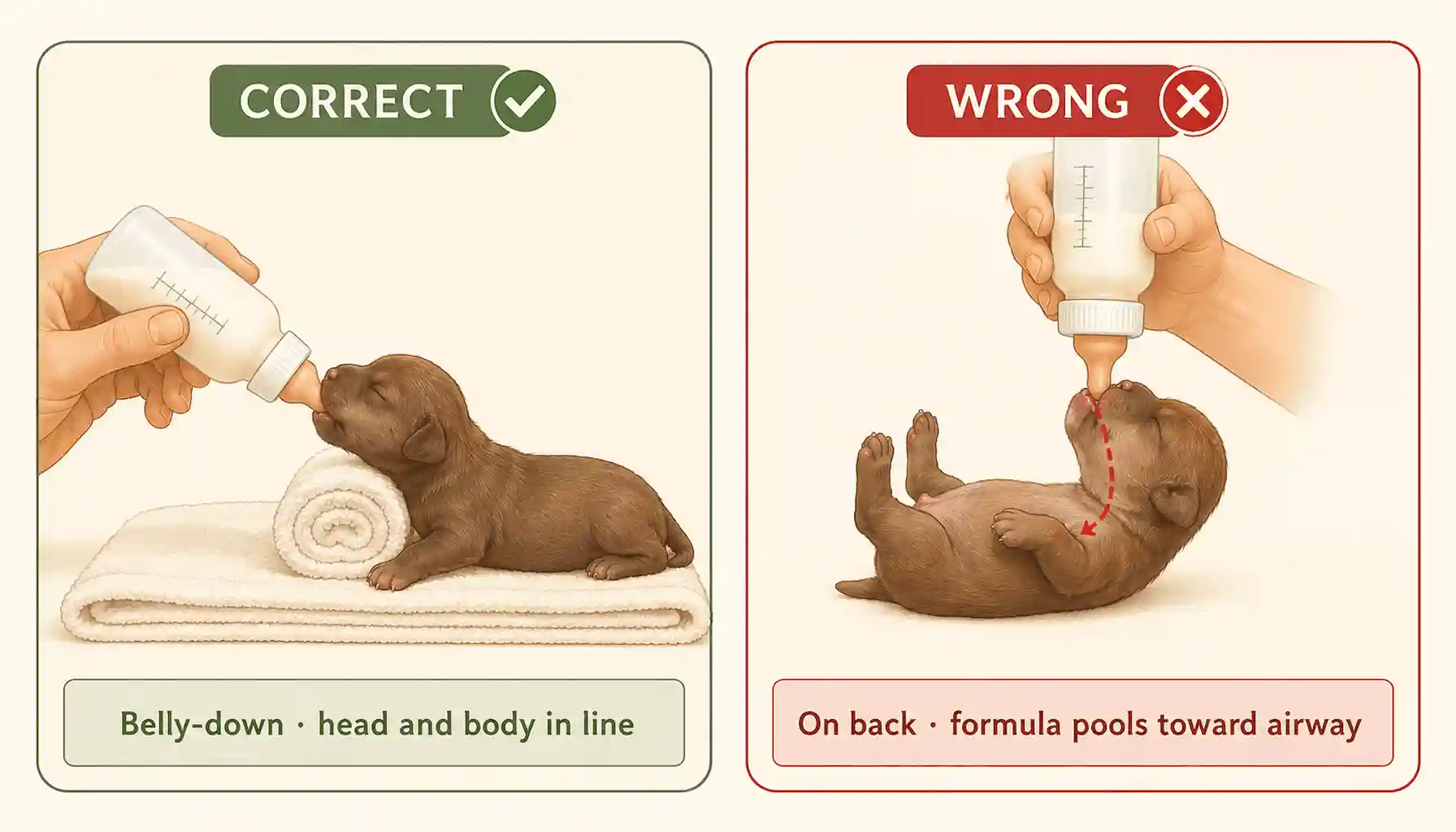
Position is the difference between a safe feed and aspiration pneumonia. Feeding the puppy on its back like a human baby is the position that sends formula toward the airway. Feed belly-down, head neutral.
The full sequence
- Before any feed: the puppy must be warm and stable. A cool puppy is warmed slowly to at least 97°F (36°C) before it is fed — a chilled gut stops moving, and formula comes back up and is inhaled. A limp, unresponsive or significantly chilled puppy is a call to the vet now, with warming started while you call.
- Warm the formula to 100°F (38°C). Reconstitute per label, then sit the container in a bowl of warm water until it tests neutral on your inner wrist. Cold formula causes regurgitation and aspiration; hot formula burns the esophagus. Never microwave.
- Position the puppy belly-down on a warm towel, with the chest propped slightly on a folded washcloth. Head and body should be in a natural straight line — not tilted up.
- Hold the bottle at a slight downward angle so the nipple stays full of formula. Air bubbles in the nipple = swallowed air = bloating and discomfort.
- Let the puppy latch and pull on its own. Never squeeze the bottle to force formula in. A healthy puppy will drink in rhythmic pulses with short pauses. The pauses are the puppy breathing — let them happen.
- Watch for aspiration: formula at the nose, gurgling, coughing, blue gums, or going limp. Stop the feed at once, keep the puppy warm and get to a vet now — tell them formula went down the wrong way. Aspiration pneumonia is an emergency, and signs can also appear hours or days later, so a puppy that inhaled formula needs a vet even if it seems to recover.
- Stop when the puppy stops. Do not coax. Belly should be gently rounded, not distended. Underfeed slightly rather than overfeed.
- Burp gently — hold belly-down against your shoulder and pat lightly between the shoulder blades. Many puppies will burp on their own; don't force it.
- Stimulate elimination (covered below) — every feed, no exceptions, for the first 2–3 weeks.
Tube feeding: measure, check placement, then deliver slowly
Tube feeding (gavage) delivers formula directly to the stomach via a soft catheter passed through the mouth and down the esophagus. It's the only safe option for puppies that can't suckle, and it's faster than bottle feeding for puppies that can't take enough volume in time.
The risk is delivering formula into the trachea instead of the esophagus, which causes immediate aspiration. Measurement, gentle insertion, and the placement checks below greatly reduce that risk.
Measure first — every time
Lay the tube against the outside of the puppy from nose tip along the jaw and down to the last rib — the landmark in Dr. Marty Greer's SFT 2021 neonatal-care handout. Mark that depth on the tube with paper tape or a permanent marker. That mark is your insertion limit — never past it.
A 2021 study that checked tube position in newborn puppies and kittens that had died found this measurement usually reaches the stomach but can also run deeper than a newborn's empty stomach safely allows, and the authors ask for confirmation in live animals — so have the vet who teaches you the technique check your first mark, and never advance past it.
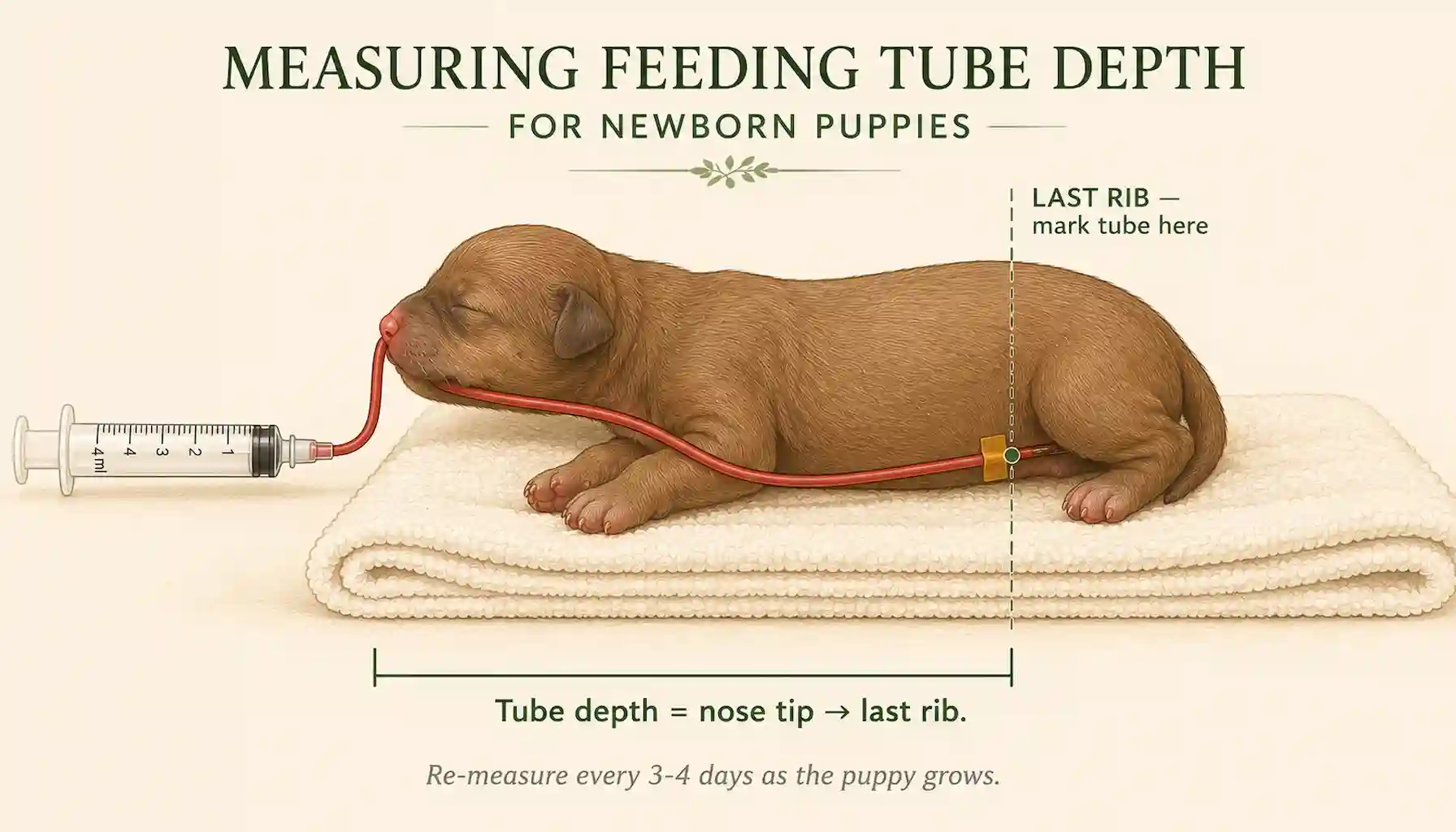
Re-measure every 2–3 days; puppies grow fast and yesterday's mark is too short by the end of the week.
The full sequence
- Before any feed: the puppy must be warm and stable (see the bottle sequence above — a cold puppy is warmed first; a limp or unresponsive one is a call to the vet now). Warm the formula to 100°F (38°C) the same way.
- Position the puppy belly-down in your hand or on a towel, with the head and body in a natural line — slight elevation of the front end is fine, but no tilt-back.
- Pass the tube with the chin down. Open the mouth gently and slide the lubricated tube tip (a drop of formula works) along the roof of the mouth, over the tongue, and into the throat. The puppy will reflexively swallow as the tube reaches the back of the throat.
- Advance smoothly to the depth mark. If you feel firm resistance, stop and withdraw — do not force.
- Check placement before the syringe goes on. Pinch a toe: Greer's checklist wants the puppy to vocalize with the tube in place. Then hold the free end of the tube in a cup of water for a few breaths — bubbles in time with breathing mean the airway. If either check fails, or you are unsure, withdraw and start over. A puppy that cries, breathes normally and swallowed the tube without resistance is the reassurance, not a guarantee; if it coughs, gags, struggles or goes blue, the tube is in the airway — withdraw.
- Attach the primed syringe — air expelled, warmed formula drawn up.
- Deliver the formula slowly and steadily, never pushed in a rush, watching the puppy the whole time. If formula appears at the nose or the puppy struggles, stop and withdraw.
- Pinch the tube shut and withdraw smoothly in one motion. Pinching prevents leftover drops from dripping into the airway during removal.
- Stimulate elimination, then weigh and record.
The feeding schedule by week: every 2 hours in week 1
Newborn puppies have tiny stomachs — roughly 4 mL per 100 g of body weight in a healthy full-term newborn — and high metabolic rates. We recommend every 2 hours in week 1, the short end of VCA's 2–4-hour range, because it keeps each feed small and protects toy breeds, which have almost no glucose reserve: Merck notes that even minimal fasting can cause hypoglycemia. As puppies grow and their stomachs expand, the interval stretches.
| Week | Interval and feeds | Per feed (per 100 g) | Per day (per 100 g) |
|---|---|---|---|
| Week 1 (days 0–7) | Every 2 h, 12 feeds, round the clock | 1.25 mL | About 15 mL |
| Week 2 (days 8–14) | Every 3 h, 8 feeds, round the clock | 2.2 mL | About 17.5 mL |
| Week 3 (days 15–21) | Every 4 h, 6 feeds | 3.3–3.75 mL | 20–22.5 mL |
| Week 4 (days 22–28) | Every 3–4 h, 7 feeds if fully hand-fed; dish meals starting | About 3.6 mL | About 25 mL |
Daily totals follow Merck's weekly energy figures (133, 155, 175–198 and 220 kcal per kg per day) converted at Esbilac's label density — 13.2 kcal per tablespoon (15 mL) when mixed 1 part powder to 2 parts water, about 0.88 kcal per mL; per feed = daily total ÷ feeds, all under the ~4 mL per 100 g stomach estimate for a healthy full-term puppy. A premature, low-birth-weight or sick puppy has a smaller stomach and gets the volumes your vet sets, not this table's.
Start each week at the low figure. A puppy gaining 5–10% a day is being fed enough. A puppy that is not gaining is a vet call (see the weight rule below), not a bigger bolus.
Week by week
- Week 1: round the clock, no overnight gap. Energy needs are lowest on days 1–3; ramp volume gradually. A dip of up to 10% of birth weight on day one is acceptable in a warm, feeding puppy — more than that is a vet call; after day one, every day should show a gain.
- Week 2: still no overnight gap. Eyes open between days 10–14 — handle gently in low light. Stimulate after every feed.
- Week 3: VCA's after-week-one range is 4–6 hours, so a puppy that is gaining well may have one overnight gap of up to 6 hours; keep the same number of feeds by spacing the daytime ones closer — do not make the boluses bigger. Puppies start standing, then walking. Offer a shallow saucer of warm formula at the end of the week — don't force it.
- Week 4: dish meals begin. A puppy still fully hand-fed needs a seventh feed to reach the day's total without any single feed filling the stomach. Cut hand feeds only as each puppy's dish intake and weight show it is eating; the remaining boluses never get bigger to compensate. Most puppies are eliminating on their own by now.
The table uses Esbilac's label density (13.2 kcal per 15 mL when mixed 1 part powder to 2 parts water, about 0.88 kcal per mL); a different formula means checking its label and adjusting proportionally. PetAg's label recommends 2 tablespoons (30 mL) per 4 oz (115 g) of body weight a day — about 26 mL per 100 g — from birth to weaning, adjusted to the individual puppy; this page's Merck-based schedule ramps up to that level over the first month rather than starting there. Our puppy tube feeding calculator uses the same Merck figures and the same label density, so it prints the same numbers for a given weight and age — and warns when a single feed would approach the stomach estimate. VCA publishes a steeper daily energy scale (up to 25 kcal per 100 g from day 7); if your vet prefers it, the puppy's daily weight is still the final word.
Overfeeding and underfeeding: the signs and what to do
Veterinary literature is consistent: underfeed slightly rather than overfeed. Overfeeding signs to watch for:
- Diarrhea — loose, yellow, curdled stool. The most common overfeeding sign.
- Distended belly — taut and round, not just gently rounded. Painful for the puppy.
- Regurgitation — formula coming back up during or shortly after feeding. Increases aspiration risk.
- Bloated, gassy puppy who cries and arches.
Diarrhea in a hand-fed newborn is a call to your vet the same day, not something to manage alone: overfeeding is one cause, and your vet may tell you to dilute the formula and cut the volume, but diarrhea is also on the neonatal sepsis list. Stop increasing volume until you have spoken to the vet. Diarrhea with a quiet, cold or bloated puppy, or one that is not gaining, is an emergency — go now.
Underfeeding is the opposite problem and equally dangerous. Signs:
- No weight gain, or a loss — on any day after the first 24 hours, or more than 10% of birth weight on day one. The most reliable warning, and a same-day vet call.
- Constant crying and restlessness — a hungry puppy doesn't settle.
- Cold to the touch — under-fed puppies can't generate heat.
- Sunken belly, weak suck, lethargy.
Stimulating pee and poop after every feed, until about 3 weeks
Newborn puppies cannot urinate or defecate without external stimulation. The dam normally licks the genital area to trigger the reflex. When you're hand-rearing, you have to do that job — every single feeding, for the first 2–3 weeks.
Without stimulation a newborn cannot empty its bladder or bowel — it becomes uncomfortable, stops feeding well, and needs a vet.
Technique
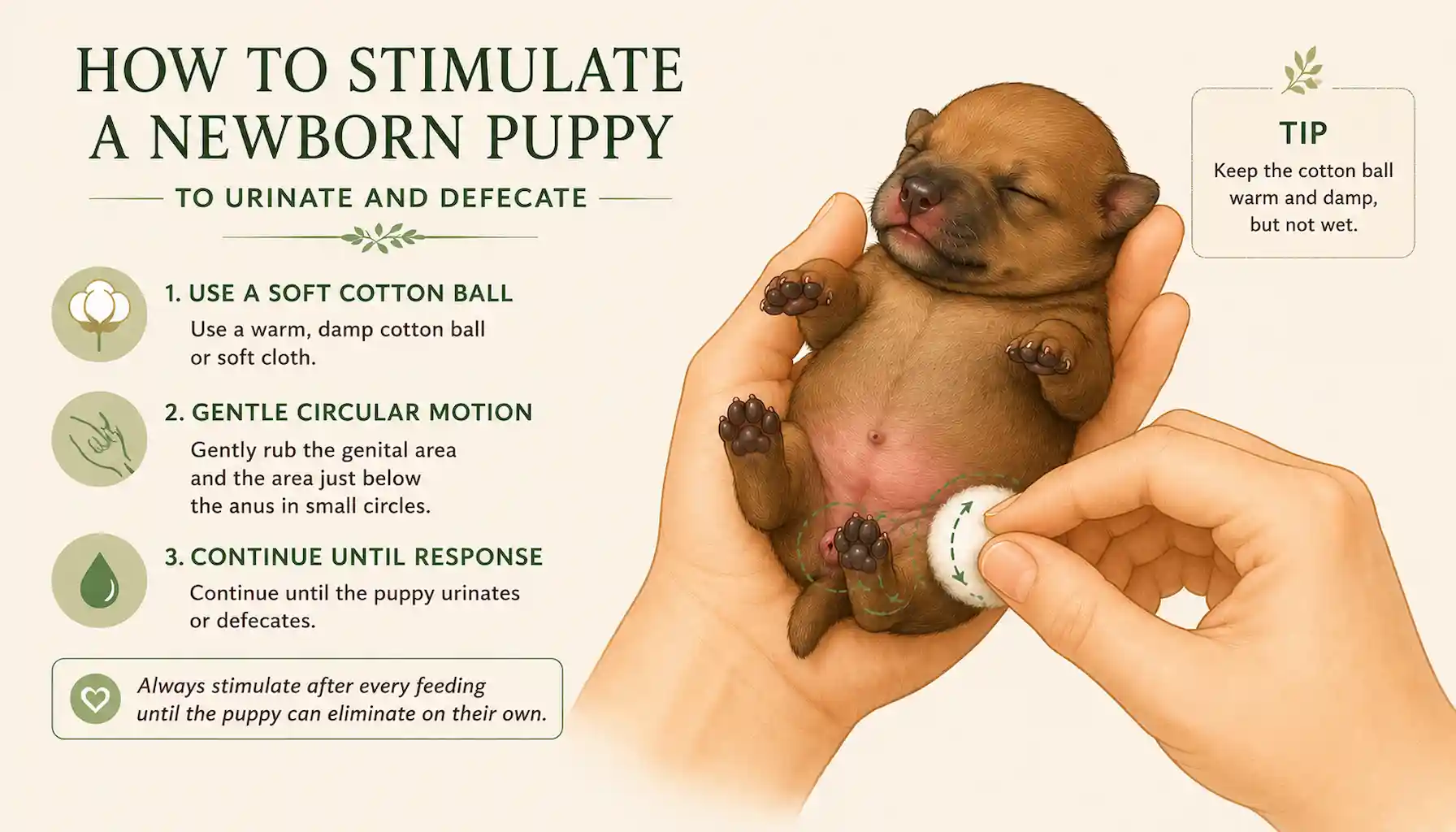
- Wet a cotton ball or soft cloth in warm water (around body temperature — warm, not hot).
- Hold the puppy belly-up in one hand, supporting the head.
- Gently stroke the area between the anus and the vulva/penis in a slow, light circular or back-and-forth motion.
- Continue for 30–60 seconds — only as long as it produces a result. The puppy should urinate (yellow drops on the cotton) and may defecate (mustard-yellow, soft).
- Wipe the area gently with a fresh damp cloth to prevent irritation.
Avoiding irritation
- Pressure: light only. You're mimicking a soft tongue, not scrubbing. Excessive pressure causes redness and skin breakdown.
- Material matters. Cotton balls and soft cotton cloths are gentle; rough washcloths and paper towels abrade delicate neonatal skin.
- Time-limit the session. If 60 seconds of gentle stroking produces nothing, stop and try again at the next feeding. Don't escalate force.
- Dry the area after each session. Persistent moisture = irritation = sores.
- Watch for redness. Pink and clean is fine; red, raw, or bleeding means too much pressure or too much friction — stop, pat dry, and apply a thin layer of plain petroleum jelly to protect the skin.
When stimulation can stop
Puppies cannot eliminate on their own until about three weeks of age. The sign that they can is what you observe: urine and stool in the box or on the bedding that you did not stimulate. Until you see that, keep stimulating after every feed.
Urine on the cotton ball should stay very pale yellow through week 2 and only slightly deeper by week 4. Dark yellow urine at any age is on the sick-puppy list — call your vet; do not simply add formula.
By the end of week 3, most puppies are eliminating on their own. Keep watching for another week — if a puppy still depends on stimulation at 4 weeks, give it a brief session after meals; it won't hurt and ensures nothing is missed.
Mistakes that kill hand-fed puppies
Aggregated from VCA, Merck Veterinary Manual, AKC and PetMD guidance, the consistent killers in hand-reared litters:
| Mistake | What goes wrong | Fix |
|---|---|---|
| Feeding a chilled puppy | A cold gut stops moving; formula comes back up and is inhaled | Warm to at least 97°F (36°C) first; limp or unresponsive = vet now |
| Feeding on the back | Formula pools toward airway → aspiration pneumonia | Always belly-down, horizontal, head neutral |
| Cold formula | Causes regurgitation, lowers core temp, shocks the digestive system | Warm to 100°F (38°C) — test on inner wrist |
| Overfeeding | Diarrhea, distended belly, regurgitation, aspiration | Underfeed slightly; let weight gain dictate volume |
| Missed or widely spaced feeds in week 1 | Hypoglycemia risk, worst in toy breeds; weight loss | Set alarms; 2-hourly, round the clock |
| Skipping stimulation | The puppy cannot empty its bladder or bowel; discomfort, poor feeding | Every feed, 30–60 sec, until it eliminates on its own (~3 weeks) |
| Cow's milk or human formula | Wrong protein/fat ratio, lactose causes fatal diarrhea | Esbilac or vet-approved milk replacer only |
| Microwaving formula | Hot spots burn the esophagus and stomach | Warm in a water bath; test on wrist |
| Unmeasured tube depth | Too short: tip in the esophagus, formula refluxes and is inhaled; too long: tip pressed into the stomach wall | Mark depth nose-to-last-rib before every insertion; vet checks the first mark |
| Forcing the tube past resistance | Esophageal trauma or false passage | Resistance = stop, withdraw, re-attempt gently |
| Ignoring weight loss | By the time you act, puppy may be in fading-puppy crisis | Weigh daily; a loss or no gain after day one = call the vet that day |
When to call your vet — immediately
Red-flag list cross-references Merck Veterinary Manual and PetMD aspiration pneumonia guidance.
- Formula at the nose, persistent gurgling, or labored breathing after a feed
- Blue or pale gray gums or tongue
- Limp, unresponsive, or significantly cooler than littermates
- A loss of more than 10% of birth weight on day one, or a loss or no gain on any day after the first 24 hours (re-weigh once to confirm)
- Diarrhea — any, in a newborn (go now if the puppy is also quiet, cold, bloated or not gaining)
- No urination after stimulation across two consecutive feeds
- Distended, painful belly between feeds
- Crying that doesn't stop after warming, feeding, and stimulation
Many of these are early signs of fading puppy syndrome, which moves fast and is often reversible with prompt veterinary care.
Weaning off the bottle or tube: weeks 3–6
Bottle and tube feeding are bridges, not the destination. Most puppies are ready to begin weaning around 3–4 weeks. The transition takes about 2 weeks and overlaps with continued bottle/tube supplementing.
- Week 3, end of: offer warm formula in a shallow saucer. Many puppies will try to lap on their own; some need a finger dipped in formula and presented to their lips.
- Week 4: blend a slurry of moistened puppy kibble (small-breed formula) with warm formula into a soup-like consistency. Offer it four times a day in shallow dishes. Cut hand feeds only as each puppy's dish intake and weight show it is eating — there is no fixed count.
- Weeks 5–6: thicken the slurry gradually toward soaked kibble, which becomes the main meal by 5–6 weeks. Formula top-ups only for a puppy not keeping up. Watch weight gain — it shouldn't slow during the transition.
Full transition guide: how to wean puppies.
Disclosure: As an Amazon Associate I earn from qualifying purchases. Links marked (paid link) are affiliate links — buying through them supports BreedTools and adds nothing to your price, and it never changes what we recommend. Full affiliate disclosure
The hand-rearing kit, if you want our picks
Four things this guide tells you to have ready. None is required to follow it, and none is a heat source.
PetAg Esbilac Puppy Milk Replacer Powder (12 oz)
Milk replacerThe formula this guide's schedule and our tube-feeding calculator are calibrated to — 13.2 kcal per tablespoon when mixed 1 part powder to 2 parts water. This listing is the 12 oz powder. Mix only what one feed needs and keep any made-up formula refrigerated for no more than 24 hours.
PetAg Nursing Kit (2 oz bottle, 5 nipples, cleaning brush)
Bottle and nipplesA 2 oz bottle with five nipples and a cleaning brush — the size that suits a newborn's 2–3 mL feeds, with gradations so you can see what went in. Enlarge a nipple hole only until formula drips one drop at a time when the bottle is held tip-down, never a stream.
Greater Goods Digital Pet Scale
Most importantReads in grams, which is what the weight rule on this page needs: a loss or no gain on any day after the first 24 hours is a same-day vet call, and a scale marked in ounces cannot show a 5 g change on a toy-breed newborn. Weigh at the same time every day.
Govee H5075 Bluetooth thermometer & hygrometer
Monitor the areaReads temperature and humidity at puppy level so you can hold the area at 85–90°F for the first four days and 55–65% humidity without guessing. It is a monitor, not a heat source — check any pad or lamp surface directly with a probe or infrared thermometer as well.
Tools and resources
- Puppy Tube Feeding Calculator — enter weight in grams, get mL per feeding and total daily volume.
- Puppy Weight Tracker — track each puppy's daily gain. Weight is the most reliable signal of whether feeding is working.
- Puppy APGAR Calculator — score newborn vitality at 5 and 60 minutes after birth to identify puppies that may need supplemental feeding.
- Fading puppy syndrome — recognize the signs early so feeding intervention can save the puppy.
- How to tube feed a puppy — focused step-by-step companion to this pillar guide.
BreedTools App · litter weights
Weigh the litter.
See who's falling behind.
This guide's weight rule is a daily log: a gram scale, every puppy, same time each day. The app keeps that log for you — and shows at a glance which pup isn't gaining.
Weigh the whole litter in a minute
Type a weight, hit enter, the next puppy is up. Same time every day.
Every puppy on the breed curve
Each pup's weights plotted against the breed's growth band. A flat line stands out.
Works in the whelping room
Log the 2 a.m. weigh-in with no signal; it syncs when you're back online.
Phone by the box, laptop later
One litter, every device — the log is always the current one.
Bring your Weight Tracker file
Export from the free tracker, import on signup. No re-entry.
The rest of the litter record
Vaccination schedule, milestones and health records for every pup.
Frequently asked questions
1When do I need to bottle or tube feed instead of letting the dam nurse?
Hand-feeding is needed when the dam can't or won't nurse, or when a specific puppy can't compete. Common scenarios: dam died, dam has severe mastitis or eclampsia, post-C-section recovery, dam rejection of one or all puppies, large litter where smaller puppies get pushed off, fading puppy syndrome, and cleft palate (which always requires tube feeding because suction can't form). When in doubt, weight is the trigger: a loss, or no gain, on any day after the first 24 hours — re-weigh once to confirm — means call your vet the same day, and so does a loss of more than 10% of birth weight on day one.
2How often do I feed a newborn puppy? Is the 2-hour rule real?
Yes — for week 1, every 2 hours around the clock (12 feedings a day, including overnight). Week 2 stretches to every 3 hours, week 3 to every 4 hours, and week 4 begins weaning. Smaller, more frequent feedings are safer than larger less-frequent ones because puppy stomachs are tiny and overfeeding causes regurgitation and aspiration. Toy breeds especially need the 2-hour cadence — they have minimal energy reserves and risk hypoglycemia if a feed is skipped.
3How much formula does a newborn puppy need per feeding?
About 1.25 mL of reconstituted Esbilac per 100 g of body weight per feeding in week 1 (12 feeds a day), 2.2 mL per 100 g in week 2 (8 feeds), and 3.3–3.75 mL per 100 g in week 3 (6 feeds) — and never enough to fill the stomach, which holds roughly 4 mL per 100 g in a healthy full-term newborn (premature, low-birth-weight and sick puppies have smaller stomachs and get their volumes from the vet). A 200 g week-1 puppy gets about 2.5 mL per feeding, about 30 mL a day. Always weigh the puppy daily and let weight gain (5–10% per day) be the final word — not the chart. Underfeed slightly rather than overfeed.
4What temperature should the formula be?
Around 100°F (38°C) — body temperature, neutral on your inner wrist. Cold formula causes regurgitation and lowers the puppy's core temperature, both of which can be fatal. Formula that's too hot burns the esophagus. Warm a small container of formula by setting it in a bowl of warm water — never microwave (it creates hot spots that scald). Test on your wrist before every feeding.
5Why can't I use cow's milk or human baby formula?
Cow's milk has less than half the protein of a dam's milk, less fat and far more lactose — the lactose causes diarrhea and dehydration in neonates, quickly lethal at this age. Human infant formula is similarly mismatched. Use a commercial puppy milk replacer such as Esbilac (PetAg), Goat's Milk Esbilac, or Royal Canin Babydog Milk. Goat's milk on its own is an emergency stopgap only — get to a vet supply or pet store the same day for proper formula.
6How do I know if a puppy is aspirating during feeding?
Aspiration signs include: formula coming out of the nose, sudden coughing or gagging, blue-tinged gums or tongue, gurgling breath sounds, rapid or labored breathing, and the puppy going limp. Newborns have a poor gag reflex, so signs may be subtle — by the time you see distress, formula may already be in the lungs. If any of these occur: stop feeding immediately, keep the puppy warm, and get to a vet now — tell them formula went down the wrong way. Aspiration pneumonia is an emergency, and signs can also appear hours or days later, so a puppy that inhaled formula needs a vet even if it seems to recover.
7How do I stimulate a newborn puppy to pee and poop?
After every feeding, hold the puppy belly-up and gently stroke the area between the anus and the vulva or penis with a warm, moist cotton ball or soft cloth. Stroke for 30–60 seconds — only as long as it produces a result. The puppy should urinate (yellow drops on the cotton) and may defecate (mustard-yellow soft stool). Without stimulation a newborn cannot empty its bladder or bowel — it becomes uncomfortable, stops feeding well, and needs a vet.
8When can I stop stimulating the puppy to eliminate?
Around 3 weeks of age, puppies develop the neurological control to urinate and defecate on their own. The sign is what you observe: urine and stool in the box or on the bedding that you did not stimulate. Until you see that, keep stimulating after every feed. Urine on the cotton ball should stay very pale yellow through week 2 and only slightly deeper by week 4 — dark yellow urine at any age is a sick-puppy sign, so call your vet rather than simply adding formula.
9What size feeding tube do I need?
A soft red-rubber feeding tube: 5 French (Fr) for a puppy under about 300 g, 8 Fr above that — the sizes reported in the veterinary literature. Size by the puppy in front of you, not the breed, and let the vet who shows you the technique confirm the size and the depth mark. The French unit measures the outside diameter (1 Fr = 0.33 mm). Stiff tubes increase the risk of esophageal damage. Always measure the depth (nose tip to last rib) and mark with tape before insertion.
10When should I move from bottle/tube feeding to weaning?
Begin weaning around 3–4 weeks. Offer a shallow saucer of warm formula at first (most puppies lap from week 3), then gradually introduce a slurry of moistened puppy kibble blended with formula. Reduce bottle/tube feedings as puppies eat more from the dish; full transition usually takes 2 weeks. Don't rush — abrupt weaning causes diarrhea. See our companion guide on how to wean puppies for the full transition timeline.
References
- VCA Animal Hospitals. Feeding Orphaned Puppies. — energy 15/20/25 kcal per 100 g per day (days 1–3, 4–6, after day 6); feed every 2–4 h in week 1; 100°F (38°C); horizontal, head-neutral position; cannot eliminate on their own until about three weeks; cow's milk comparison; formula handling.
- Merck Veterinary Manual. Management of the Neonate in Dogs and Cats. — 133/155/175–198/220 kcal per kg per day, weeks 1–4; up to 10% loss on day one then 5–10% daily gain; body temperature ≥ 97°F; humidity 55–65%; hypothermia and aspiration; diarrhea and sepsis signs; antibody absorption ceases by 24 h.
- Greer M. Neonatal Care (Society for Theriogenology, 2021). — the 6 P's of tube feeding; normal urine color by week and dark urine as a sick-puppy sign; colostrum window; 5–10% daily gain.
- Furthner E, Kowalewski MP, Torgerson P, Reichler IM. Verifying the placement and length of feeding tubes in canine and feline neonates. BMC Veterinary Research 2021. — nose-to-last-rib measurement in newborn cadavers; 5 Fr under 300 g, 8 Fr above.
- American Kennel Club. Raising Newborn Puppies. — warm a chilled puppy before feeding; heat source in one corner; stimulation with a warm wet cotton ball.
- Fontaine E, DVM. How to feed newborn puppies. — stomach volume roughly 4 mL per 100 g, smaller in premature and low-birth-weight puppies.
- VCA Animal Hospitals. Breeding for Dog Owners: Caring for Newborn Puppies. — 85–90°F for the first four days, about 80°F by day 7–10, about 72°F by the end of week 4.
- PetMD. Aspiration Pneumonia in Dogs. — signs; an emergency; signs can appear days later.
- PetAg. Esbilac Puppy Milk Replacer Powder (product label) and Puppy & Kitten Feeding Schedule. — mix 1 part powder to 2 parts water; 13.2 kcal per tablespoon reconstituted; 2 tablespoons (30 mL) per 4 oz (115 g) of body weight daily.
Related Tools
Sources: VCA Animal Hospitals (Feeding Orphaned Puppies; Caring for Newborn Puppies); Merck Veterinary Manual (Management of the Neonate in Dogs and Cats); Greer M, Neonatal Care (SFT 2021); Furthner et al., BMC Veterinary Research 2021; Fontaine E, DVM; American Kennel Club; PetMD; PetAg. This article is for educational purposes and does not replace professional veterinary care.