Dog Coat Color Genetics Calculator
Affiliate links on this page are marked (paid link); BreedTools may earn a commission at no extra cost to you.
Coat Color Genetics Calculator
Predict your puppies' coat colors based on the sire and dam's colors. Select a breed group, choose each parent's color, and optionally note known carrier status for more precise results.
Choose a breed group to start
How coat color genetics works
Dog coat color is controlled by several genes, each with dominant and recessive alleles. The two most fundamental loci are the B locus (black vs. brown pigment) and the E locus (extension — whether dark pigment shows in the coat). Understanding these two genes alone explains most coat color outcomes in breeds like Labrador Retrievers.
Key color loci in dogs
| Locus | Dominant | Recessive |
|---|---|---|
| B (Brown) — black vs. brown pigment | B — black pigment | b — brown / liver / chocolate |
| E (Extension) — pigment expression | E — allows dark pigment | e — yellow / red / cream only |
| K (Dominant Black) — solid color vs. pattern | KB — solid color (black, brown, or their dilutes) | kbr — brindle; ky — allows A-locus patterns |
| A (Agouti) — pattern type | Ay — sable / fawn; aw — wolf sable (GSD) | at — tan points; a — recessive black |
| D (Dilute) — pigment intensity | D — full intensity | d — diluted (blue; lilac when combined with bb) |
| M (Merle) — mottled pattern | M — merle pattern | m — solid (no merle) |
| S (Spotting) — white markings | S — solid color | sp — piebald / parti |
Loci, alleles, and dominance order follow Schmutz & Berryere, “Genes affecting coat colour and pattern in domestic dogs: a review,” Animal Genetics 38 (2007): 539–549.
Dominant vs. recessive inheritance
A dominant allele needs only one copy to be expressed — if a dog has one B and one b, it will have black pigment (black is dominant). A recessive allele needs two copies to show — a dog must be bb to have brown/chocolate pigment. This is why two black-appearing dogs can produce chocolate puppies: both parents can be Bb (carrying one hidden copy of brown).
Common inheritance patterns
| Cross | Expected puppies | Notes |
|---|---|---|
| Black (BB EE) × Black (BB EE) | 100% Black | Neither carries chocolate or yellow |
| Black (Bb EE) × Black (Bb EE) | 75% Black, 25% Chocolate | Both carry chocolate, neither carries yellow |
| Black (Bb Ee) × Black (Bb Ee) | 56% Black, 19% Choc, 25% Yellow | Both carry both recessives |
| Chocolate (bb EE) × Chocolate (bb EE) | 100% Chocolate | Yellow appears only if both carry e |
| Yellow (ee) × Yellow (ee) | 100% Yellow | Nose pigment (black vs. liver) still follows the B locus |
| Sable (aw/at) × Sable (aw/at), GSD | ~75% Sable, ~25% Black & Tan | GSD sable is the aw allele, dominant over tan-point (at) |
| Merle (M/m) × Non-merle (m/m) | ~50% Merle, ~50% Solid | Safe only when the solid parent is DNA-confirmed m/m — cryptic merles look solid |
Mendelian ratios for the parent genotypes shown; real parents may differ.
Why phenotype prediction has limits
This calculator uses visible coat color (phenotype) as input, not DNA test results (genotype). A black dog could be BB EE, Bb EE, BB Ee, or Bb Ee — four genotypes that look identical and produce very different litters. For breeding programs where color accuracy matters, invest in a DNA color panel test. Providers like Embark, Wisdom Panel, and UC Davis VGL offer comprehensive color genotyping for $80–$200 per dog.
Disclosure: As an Amazon Associate I earn from qualifying purchases. Links marked (paid link) are affiliate links, including Chewy affiliate links — buying through them supports BreedTools and adds nothing to your price, and it never changes what we recommend. Full affiliate disclosure
Know their genetics
A DNA panel tells you each parent's carrier status — the input this calculator otherwise has to guess. Labrador parents can have tested carrier status entered directly (including a yellow parent's B locus); for other breeds, read the prediction against the tested genotypes.
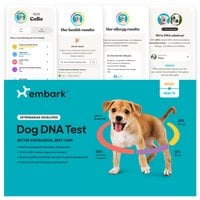
Embark Breed + Health Kit
Premium pickThe breeder-standard panel — tests every color locus this calculator estimates (B, E, K, A, D, M, S) plus 270+ health conditions. One swab replaces guessed carrier status with a tested result.
Wisdom Panel Premium
Value pickCovers the same core color loci and 265+ health tests at a lower price. A solid choice when you mainly want carrier status for color planning rather than the full breeder toolset.

More DNA test kits
Compare the full range of canine DNA panels, including breed-ID-only and single-locus color tests.
Coat color genetics FAQs
1How does coat color inheritance work in dogs?
Dog coat color is determined by multiple genes, but two are most important: the B locus (brown/liver) and the E locus (extension/yellow). The B locus determines whether dark pigment is black (B) or brown (b). The E locus determines whether dark pigment shows in the coat (E) or the coat is restricted to yellow/red (e) — nose and skin pigment still follow the B locus. Both b and e are recessive, meaning a dog needs two copies to show the recessive color.
2Can two black Labs have yellow or chocolate puppies?
Yes. If both black Labrador parents carry the recessive yellow gene (Ee), about 25% of their puppies will be yellow. Similarly, if both carry the recessive chocolate gene (Bb), about 25% will be chocolate (when neither also carries yellow). If both carry both recessives (BbEe), the litter can include all three colors — approximately 56% black, 19% chocolate, and 25% yellow.
3What determines Golden Retriever shade?
Golden Retriever coat shade (light cream to dark red) is controlled by multiple modifier genes, making it polygenic rather than a simple dominant/recessive trait. Two gold parents can produce puppies ranging from slightly lighter to slightly darker than themselves. Breeding light to dark tends to produce medium-gold puppies with a wide shade range in the litter.
4Why is the merle gene important to understand?
Merle (M locus) creates a mottled/patchy coat pattern and is dominant — one copy usually produces the merle pattern, though a short 'cryptic' merle allele can leave a dog looking solid, which is why merle status should be DNA-tested before breeding. However, breeding two merle dogs together (merle × merle) can produce 'double merle' puppies (MM), which are associated with serious health problems including deafness and eye defects. Responsible breeders never cross two merle dogs.
5How accurate is this calculator?
For Labrador Retrievers, the predictions are quite accurate because Lab coat color follows well-understood Mendelian genetics at the B and E loci. For other breeds, predictions are estimates based on general dominance patterns. The tool uses phenotype (visible color) rather than genotype (DNA), so hidden carrier genes can produce unexpected results. A DNA color panel replaces guessed carrier status with tested genotypes for the loci it covers.
6What is carrier status and why does it matter?
A carrier is a dog that looks one color but carries a hidden recessive gene for another color. For example, a black Lab that is Bb carries chocolate — it looks black but can produce chocolate puppies when bred to another chocolate carrier. Knowing carrier status (through DNA testing or breeding history) dramatically improves prediction accuracy.
7Should I DNA test my breeding dogs for color?
Yes, if you are serious about predicting puppy colors or avoiding health-linked color combinations. A DNA color panel test from Embark, Wisdom Panel, or UC Davis VGL costs $80–$200 and reports the genotype at the major color loci (B, E, K, A, D, M, S). This is especially important for breeds where certain color combinations carry health risks, such as double merle.
8Can puppy coat color change as they grow?
Yes, many breeds experience significant coat color changes from puppyhood to adulthood. Dalmatian puppies are born white and develop spots over weeks. Some breeds like Kerry Blue Terriers are born black and lighten to blue-gray as adults. Golden Retrievers often darken with age, and many sable-coated breeds shift shading as the adult coat grows in. The color you see at 8 weeks is not always the color you get at 2 years.