Inbreeding Coefficient (COI) Calculator
Affiliate links on this page are marked (paid link); BreedTools may earn a commission at no extra cost to you.
♂Sire Side
Sire's Parents
Sire's Grandparents
♀Dam Side
Dam's Parents
Dam's Grandparents
This calculator estimates COI from name matches within a 3-generation pedigree using Wright's formula. Enter each ancestor once per position — repeating the same dog in deeper slots can inflate the result. Because it only sees 3 generations, pedigree COI usually underestimates true inbreeding; for the most accurate value use genomic testing (Embark, Wisdom Panel), which measures actual DNA homozygosity.
Understanding the Coefficient of Inbreeding
What COI measures
The Coefficient of Inbreeding (COI) measures the probability that a dog inherits two identical copies of a gene from the same ancestor. A higher COI means more genetic homozygosity — the dog is more likely to be homozygous at any given gene, which is the entire point of linebreeding: concentrating the qualities of a chosen line.
Every recognized breed exists because foundation breeders systematically linebred to fix type. Top show kennels run linebred programs at 15–25% COI consistently because that's how predictable type, temperament, and structure get reproduced across generations. COI is a tool to understand a pairing — outcross, light linebreeding, tight linebreeding, or close inbreeding — not a number to minimize.
Wright's formula
Developed by Sewall Wright in 1922, the formula calculates COI by tracing every path through the pedigree that connects the sire and dam through a common ancestor. For each common ancestor, the contribution to COI is (1/2) raised to the power of (n1 + n2 + 1), where n1 and n2 are the number of generations separating the sire and dam from that ancestor. A half-sibling mating, for example, doubles on one shared parent (one generation from each side): (1/2)(1+1+1) = 12.5%.
This calculator applies that formula directly to the names you enter, summing the contribution of every ancestor that appears on both the sire and dam sides of a 3-generation pedigree. Enter each dog once per position — if the same dog legitimately fills several deeper slots (as in a parent-offspring or full-sibling pairing), a simple name match can overstate the total, so cross-check very close matings with dedicated pedigree software or a DNA-based genomic COI.
| Relationship | COI | Strategy |
|---|---|---|
| Unrelated (outcross) | 0% | Outcross |
| Share 1 great-grandparent | 3.1% | Light linebreeding |
| Share 2 great-grandparents | 6.25% | Light linebreeding |
| Half-siblings | 12.5% | Moderate linebreeding |
| Uncle/niece or aunt/nephew | 12.5% | Moderate linebreeding |
| Double first cousins | 12.5% | Moderate linebreeding |
| Grandparent to grandchild | 12.5% | Tight linebreeding |
| Parent-offspring | 25% | Close inbreeding |
| Full siblings | 25% | Close inbreeding |
Wright's Coefficient of Inbreeding (Sewall Wright, 1922)
Selection is what makes linebreeding work
The reason linebreeding works in pedigreed dogs is selection. Working breeders don't just breed related dogs randomly — they choose sound, structurally-correct, health-tested, type-correct stock to concentrate. Generations of selection remove the dogs that don't hold up. What gets passed forward is the best of the line.
Programs run 15–25% pedigree COI for decades and produce sound, long-lived, healthy dogs. The proof is in the breeds themselves — every breed standard you can think of was created and is maintained through this exact process.
Pedigree COI vs. genomic COI
This calculator estimates COI from a 3-generation pedigree. A DNA-based COI, such as Embark's, adds information from genetic markers in the tested dog. Wisdom Panel reports a genetic diversity score using a different method. These results complement pedigree information, but their percentages are not interchangeable. Compare dogs using the same test method and review the relevant breed-specific health results.
Disclosure: As an Amazon Associate I earn from qualifying purchases. Links marked (paid link) are affiliate links, including Chewy affiliate links — buying through them supports BreedTools and adds nothing to your price, and it never changes what we recommend. Full affiliate disclosure
Add DNA information to your pedigree records
Compare the specific health and diversity information each kit reports. DNA panels do not replace all breed-specific health examinations.
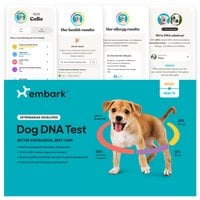
Embark Breed + Health Kit
Reports genetic COIEmbark's DNA-based COI adds information beyond the ancestors entered into this pedigree calculator. The Breed + Health kit also screens for listed health variants; check that the panel includes the conditions relevant to your breed.
Wisdom Panel Premium
Health & diversityA health-variant panel with a genetic diversity score. Wisdom Panel uses a different diversity method from Embark, so the figures are not interchangeable. Check the current condition list against your breed-specific testing needs.

More DNA test kits
Compare the full range of canine DNA panels, from breed-ID-only to full health-and-diversity tests.
Inbreeding coefficient FAQs
1What is the Coefficient of Inbreeding (COI)?
The Coefficient of Inbreeding (COI) is a number that expresses the probability that two alleles at any gene are identical by descent — meaning they came from the same ancestor. A COI of 0% means the parents share no common ancestors, while a COI of 25% means the pairing is equivalent to a full-sibling or parent-offspring mating. The formula was developed by geneticist Sewall Wright in 1922 and is the standard measure of inbreeding in animal breeding.
2Is this a free inbreeding coefficient calculator?
Yes. This is a completely free coefficient of inbreeding calculator — no account, no download, and no limit on how many pairings you run. It applies Wright's formula to the 3-generation pedigree you enter, and everything stays in your browser. 'Inbreeding coefficient,' 'coefficient of inbreeding,' and 'COI' all name the same number, so whichever term your breed club or registry uses, this calculator computes it the same way.
3Can I use this as a KC COI calculator or COI checker?
Yes. 'COI checker', 'KC COI calculator', and 'inbreeding calculator' are all searches for the same kind of tool — one that estimates a pedigree COI. The Royal Kennel Club (the KC, UK) publishes its own inbreeding coefficient calculators online for KC-registered dogs; they use every generation the KC holds electronically, so the KC figure is usually higher than a 3-generation result. This checker is a simplified estimate: it works for any dog — KC, AKC, FCI, or unregistered — from the 3-generation pedigree you type in, and it will not match the KC's number exactly. UK breeders: use the KC's calculator when both dogs are registered, and this one to test hypothetical pairings or dogs the registry doesn't hold.
4What COI do working breeders actually run?
Top show kennels in most breeds run 15–25% pedigree COI consistently. Linebreeding is the foundational tool of pedigreed breeding — every recognized breed exists because foundation breeders bred related dogs to fix type. Quality programs deliberately concentrate a chosen producer (grandparent or great-grandparent doubled on both sides) to lock in type, temperament, and structure. The 'low COI is responsible' framing comes from population geneticists worried about breed-wide diversity; that's a real concern at the breed level but it isn't how individual successful programs are run.
5What is the difference between linebreeding and inbreeding?
Genetically there's no difference — both concentrate the genetics of a common ancestor. 'Linebreeding' is the term breeders use when the common ancestor is further back in the pedigree (great-grandparent or grandparent doubled). 'Inbreeding' is used colloquially for closer pairings like parent-offspring, full sibling, or half sibling. The labels are cultural; the math is the same. Both are legitimate tools used at different times for different reasons.
6Is close inbreeding (siblings, parent-offspring) registerable?
Yes. AKC, FCI, and most major kennel clubs DO NOT prohibit full-sibling, parent-offspring, or half-sibling matings. They are registerable. Some breed-specific clubs have guidelines or recommendations, but it's not a universal rule. Close inbreeding is used strategically — to lock in a specific producer, to rebuild from a single exceptional dog, or as a one-generation diagnostic to surface what a line carries before outcrossing in the next generation.
7Is a DNA-based COI better than a pedigree-based COI?
They answer related but different questions. Pedigree COI estimates shared ancestry from the recorded pedigree, while a DNA-based estimate such as Embark COI uses genetic markers in the tested dog. Wisdom Panel reports a genetic diversity score using a different method; it is not interchangeable with Embark COI. Use the report alongside pedigree and breed-specific health information, and compare results calculated with the same method.
8What does Wright's formula actually calculate?
Wright's Coefficient of Inbreeding formula calculates: F = Sum of [(1/2)^(n1+n2+1) × (1 + Fa)] for each common ancestor, where n1 is the number of generations from the sire to the common ancestor, n2 is the number of generations from the dam to the common ancestor, and Fa is the COI of the common ancestor itself. For example, in a half-sibling mating, the common parent is 1 generation from both sire and dam: F = (1/2)^(1+1+1) = 12.5%.
9When does outcrossing make sense?
Outcrossing is a tool, not a moral default. Working programs use it for specific purposes: to introduce a structural correction the line lacks, to bring in a missing health clearance, to break up a fault, or to address a genuine breed-wide bottleneck. The standard formula is: outcross to bring in something specific, then linebreed back over the next generations to fix the new trait. Outcross matings without a goal often produce unpredictable type and lose the consistency the program was built on.
10Why do some breeds have higher average COI than others?
Breeds with small founding populations, popular sire effects (one stud producing many litters), closed registries, and breed bottlenecks tend to have higher average COI. For example, breeds like the Basenji, Norwegian Lundehund, and English Bulldog have limited genetic diversity due to small gene pools. Breeds with larger populations and more diverse breeding practices (like Labrador Retrievers) tend to have lower average COI.