Weaning is the gradual transition from a puppy's complete dependence on the dam's milk to eating solid food independently. It's one of the most significant transitions in early puppy life — and getting it right matters for both the puppies and the dam.
Done well, weaning is a smooth, stress-free process that takes 3–4 weeks. Done poorly or rushed, it can cause digestive upset, weight loss, and unnecessary stress for the entire litter. This guide walks through the complete process from first gruel to independent eating.
When to start weaning
Most breeders begin weaning around 3–4 weeks of age. The exact timing depends on the individual litter, but there are reliable signs that puppies are ready:
- Teeth are emerging — the first incisors appearing around 2–3 weeks signal that puppies are physiologically preparing for solid food. Those sharp teeth also make nursing increasingly uncomfortable for the dam
- Interest in food — puppies start nosing around the dam's food bowl or licking at her mouth (a natural food-solicitation behavior)
- Ability to lap — puppies can drink from a shallow dish, which means they can physically manage gruel
- Mobility — puppies are walking and can get themselves to a food dish
Don't rush it. A puppy that shows no interest at 3 weeks may be ready at 4. Toy breed puppies often start slightly later than larger breeds. Let the puppies guide the timing while gently encouraging exploration.
Preparing gruel — the first food
The first solid food puppies eat isn't really solid at all. Gruel is puppy kibble blended with warm liquid to a thin, soupy consistency — think runny oatmeal.
Basic gruel recipe
- 1 part high-quality puppy kibble (the same brand you plan to send home with buyers)
- 3 parts warm water or puppy milk replacer (not cow's milk — it causes diarrhea)
- Blend or soak until smooth and pourable. No chunks for the first feedings
Some breeders prefer to start with canned puppy food thinned with water, which has a stronger smell that attracts puppies. Either approach works — the key is starting very liquid and gradually thickening over time.
Disclosure: As an Amazon Associate I earn from qualifying purchases. Links marked (paid link) are affiliate links, including Chewy affiliate links — buying through them supports BreedTools and adds nothing to your price, and it never changes what we recommend. Full affiliate disclosure
Options for the first weaning meals
Choose food for your litter's feeding plan; neither product is a required extra.
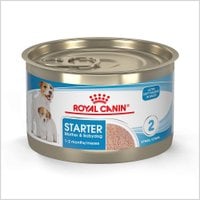
Royal Canin Mother & Babydog Starter Mousse (24 cans)
Soft weaning foodAn ultrasoft starter mousse formulated for the weaning stage. This listing is a case of 24 cans, 5.1 oz each. Follow the product's feeding guide and your veterinarian's plan; it is an option, not a reason to abruptly change a food your litter tolerates.
PetAg Esbilac Puppy Milk Replacer Powder (12 oz)
Optional replacerA puppy milk replacer for a feeding plan that calls for it. Reconstitute the powder with water according to its own label before using prepared replacer in gruel; dry powder is not the same as the recipe's liquid. Healthy nursing puppies do not automatically need supplementation.
The transition schedule
Weaning is gradual. The table below shows a typical progression from first introduction to full independence. Adapt the pace to your litter — some progress faster, some need an extra few days at each stage.
| Stage | Age | Food Consistency | Meals/Day | Dam Separation |
|---|---|---|---|---|
| Introduction | Week 3–4 | Very thin gruel (soupy). 1:3 kibble to liquid. | 1–2 meals | 0–1 hr during meals |
| Early weaning | Week 4 | Thin gruel. Puppies lapping reliably. | 3 meals | 1–2 hrs during meals |
| Mid weaning | Week 5 | Thicker gruel (porridge-like). 1:2 ratio. | 3–4 meals | 2–4 hrs. Dam visits between meals. |
| Late weaning | Week 6 | Softened kibble. Minimal blending needed. | 3–4 meals | Most of day away. Brief nursing visits. |
| Nearly done | Week 7 | Moistened kibble. Recognizable pieces. | 3 meals | Dam mostly separated. Brief visits only. |
| Complete | Week 8 | Kibble with warm water added. Puppies eat independently. | 3 meals | Fully weaned. Dam visits for socialization only. |
General schedule — individual litters vary. Toy breeds may need an additional 1–2 weeks. Always adjust based on puppy weight trends.
Monitoring weight during weaning
Weaning is one of the most important times to track weight. The transition from milk to solid food is a period of nutritional change, and some puppies handle it better than others.
A healthy puppy should continue to gain weight throughout weaning. Growth rate may slow slightly compared to the rapid gains of the first two weeks, but the overall trend must remain upward.
Common causes of weight loss during weaning include:
- Gruel too thick too fast — puppies can't eat enough to maintain calories
- Dam separated too quickly — nursing calories removed before solid food intake compensates
- Competition at the dish — larger puppies dominating access to food
- Digestive upset — diarrhea from the food change reducing nutrient absorption
The fix is usually straightforward: slow down the transition, thin the gruel back out, allow more nursing time, or feed smaller puppies separately.
Separating the dam
Weaning is a two-way process. While puppies learn to eat solid food, the dam's body needs to gradually reduce milk production. Abrupt separation can cause painful engorgement and mastitis in the dam.
The separation should be gradual and increasing:
- Weeks 3–4: Remove the dam for 1–2 hours during meal times. She returns for nursing between meals
- Week 5: Separation increases to 2–4 hours. The dam still has access for supervised nursing sessions
- Week 6: The dam spends most of the day away from puppies, with brief visits for nursing (which is now more comfort than nutrition)
- Weeks 7–8: Nursing stops or becomes very brief. The dam may visit for socialization but puppies are nutritionally independent
Watch the dam's mammary glands throughout this process. Mild firmness is normal as milk production decreases, but hot, hard, or painful glands may indicate mastitis and need veterinary attention. For guidance on adjusting the dam's nutrition as her milk production tapers, see our guide on feeding the nursing dam.
Common problems during weaning
Puppy refuses to eat
Some puppies take longer to show interest in gruel. Try warming the food slightly (body temperature is ideal), adding a small amount of canned puppy food for flavor, or smearing a thin layer on the puppy's lips so they lick it off and taste it. Most puppies come around within a few days. If a puppy is still refusing all food by week 5, consult your veterinarian.
Diarrhea
Mild loose stool is common when puppies first start gruel. If it persists beyond 24–48 hours or is severe, slow down the transition — thin the gruel back out and progress more gradually. Persistent diarrhea with weight loss needs veterinary evaluation to rule out parasites or other causes.
Dam still nursing too long
Some dams are reluctant to stop nursing, especially first-time mothers. If the dam is still nursing freely at 6–7 weeks, increase physical separation time. The puppies don't need the nutrition at this point, and continued nursing can interfere with the dam's recovery and the puppies' transition to solid food.
One puppy not gaining like the others
Competition at the food dish often means smaller or less assertive puppies eat less. Solution: feed smaller puppies separately, or use a muffin tin with individual portions so each puppy has their own space. The Weight Tracker makes it easy to compare individual puppies and spot who's falling behind.
What to feed
Use a high-quality puppy food appropriate for your breed size (small breed, large breed, or all-breed puppy formula). The food you choose for weaning is typically the same food you'll send home with buyers, so choose something widely available.
- Puppy-specific formula — higher protein and fat than adult food, plus the calcium and phosphorus ratios growing puppies need
- Large breed puppy food for large/giant breeds — controlled calcium levels to support proper skeletal development
- Avoid raw food during weaning — neonatal immune systems are immature, and the risk of bacterial contamination outweighs any benefit. If raw is your eventual goal, our raw feeding guide covers how and when to safely transition older puppies and adults
For detailed calorie calculations during the weaning period, use the Food & Calorie Calculator to determine how much your growing puppies need based on their current weight and age.
For the broader context of puppy development during this period, see our week-by-week puppy development guide. If a puppy's weight trend becomes concerning during weaning, review when weight gain becomes a concern. And for early warning signs that something more serious may be happening, see our guide to fading puppy syndrome.
Weaning FAQs
When should you start weaning puppies?
What do you mix for puppy gruel?
How long does weaning take?
Should the dam be separated during weaning?
What if a puppy refuses solid food?
Related Tools
Sources: Merck Veterinary Manual (Nutrition in Puppies and Kittens); Association of American Feed Control Officials (AAFCO) Dog Food Nutrient Profiles for Growth; WSAVA Global Nutrition Guidelines; BSAVA Manual of Canine and Feline Reproduction and Neonatology; Hand MS et al. Small Animal Clinical Nutrition (5th ed.). Mark Morris Institute. This article is for educational purposes and does not replace professional veterinary care. Consult your veterinarian for nutritional concerns specific to your litter.