Dog Crate Size Calculator
Affiliate links on this page are marked (paid link); BreedTools may earn a commission at no extra cost to you.
How to choose the right crate size
A properly sized crate is one of the most important tools for house training, travel safety, and giving your dog a secure space of their own. Too small and your dog will be uncomfortable. Too large and a puppy will use one end as a bathroom. Getting the size right matters.
The golden rule of crate sizing
Your dog should be able to stand up without their head touching the top, turn around in a full circle, and lie down with legs extended. The crate should not be so spacious that they can walk around freely — that defeats the den-like purpose. Measure nose to tail base and floor to the top of the head or ear tips, then add about 2–4 inches to each.
Standard crate sizes by breed weight
| Crate size | Weight range | Example breeds |
|---|---|---|
| 24" (61 cm) | Under 25 lbs | Chihuahua, Yorkie, Pomeranian, Maltese |
| 30" (76 cm) | 25–40 lbs | Beagle, Cocker Spaniel, French Bulldog, Corgi |
| 36" (91 cm) | 40–70 lbs | Border Collie, Bulldog, Aussie, Springer Spaniel |
| 42" (107 cm) | 50–90 lbs | Labrador, Golden Retriever, Boxer, Husky |
| 48" (122 cm) | 70–110 lbs | German Shepherd, Rottweiler, Doberman, Weimaraner |
| 54" (137 cm) | Over 110 lbs | Great Dane, Mastiff, Saint Bernard, Irish Wolfhound |
Sizes are guidelines by weight; the calculator's size groups are broader — a dog at the top of its group may need the next size. Always measure your individual dog for the best fit.
The 24–48 inch dimensions are MidWest's published iCrate sizes.
Home training crates vs. airline travel crates
Home crates are typically wire or fabric and prioritize ventilation and visibility. Airline travel crates must meet the IATA Live Animals Regulations: the container size is worked out from the dog's own measurements (length = nose to tail root + ½ floor-to-elbow height, width = 2 × shoulder width, height = floor to ear tips), snub-nosed breeds need a container 10% larger, and the regulations plus the airline's own policy set the construction, ventilation and door rules.
Puppy crates and dividers
For puppies, buy a crate sized for the expected adult size and use a divider panel to limit the usable space. Adjust the divider as your puppy grows. This prevents the puppy from toileting in one corner while sleeping in another, which is the key to effective crate-based house training.
Disclosure: As an Amazon Associate I earn from qualifying purchases. Links marked (paid link) are affiliate links, including Chewy affiliate links — buying through them supports BreedTools and adds nothing to your price, and it never changes what we recommend. Full affiliate disclosure
Crates that match the calculator's sizes
Buy for the adult size the calculator gave you and use the divider while the puppy grows.
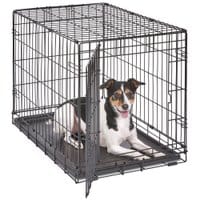
MidWest iCrate folding crate with divider
Home & puppy crateThe standard folding wire crate with the divider panel the puppy-crate advice above depends on. Pick the size the calculator gave you on the listing — 24, 30, 36, 42 or 48 inches; there is no iCrate for a 54-inch result. Home use only; it is not an airline crate.
More dog crates
Compare sizes, door styles and hard-shell kennels for the size the calculator gave you.
Crate training tips for breeders
Breeders who introduce crate concepts early — placing an open crate in the whelping area during the socialization period (4–8 weeks) — produce puppies that transition to crate training far more easily in their new homes. The crate becomes a familiar object rather than a frightening one.
| Age | Max crate time | Notes |
|---|---|---|
| 8–10 weeks | 30–60 minutes | Introduce gradually with treats and positive association |
| 11–14 weeks | 1–3 hours | Short sessions, always with a potty break before and after |
| 15–16 weeks | 3–4 hours | Can handle longer stretches but still needs frequent breaks |
| 17 weeks – 6 months | 3–4 hours | Age in months plus one hour, capped at 3–4 hours at a time |
| 6+ months | 4–5 hours during the day | Never use the crate as all-day storage |
Humane World for Animals (formerly the Humane Society of the United States), Crate training 101: adults no more than 4–5 hours during the day; puppies their age in months plus one hour, and no more than 3–4 hours at a time under six months. Puppies with smaller bladders may need more frequent breaks.
Sources: IATA Traveler's Pet Corner, container requirements (minimum internal dimensions: length A + ½B, width 2 × C, height D + bedding; snub-nosed breeds 10% larger); Humane World for Animals, “Crate training 101” (adults no more than 4–5 hours during the day; puppies age in months + 1 hour; under six months no more than 3–4 hours at a time); Chewy, “What size crate does my dog need?” (measuring: nose tip to tail base, paw to top of head; add four inches); Impact Dog Crates, “How to measure your dog accurately for crate sizing” (add 2 to 4 inches); and MidWest Homes for Pets, iCrate (sizes and the included divider panel).
Crate sizing FAQs
1How do I measure my dog for a crate?
Measure length from the tip of the nose to the base of the tail (not the tail tip). Measure height from the floor to the top of the ears (or top of the head for floppy-eared breeds). Add 2–4 inches to each measurement for the minimum crate size.
2What size crate does my puppy need?
Buy a crate sized for your puppy's expected adult size, then use a divider to limit the space while they grow. The crate should be large enough for them to stand, turn around, and lie down, but not so large that they can toilet in one end and sleep in the other.
3What are the standard crate sizes?
Standard crate sizes are 24 inches (small breeds under 25 lbs), 30 inches (medium breeds 25–40 lbs), 36 inches (medium-large breeds 40–70 lbs), 42 inches (large breeds 50–90 lbs), 48 inches (extra-large breeds 70–110 lbs), and 54 inches (giant breeds over 110 lbs).
4What are the IATA crate requirements for airline travel?
The crate must let the dog stand without touching the top, turn around, and lie down naturally. IATA sets the minimum internal size from four measurements: length = nose to tail root plus half the floor-to-elbow height, width = twice the shoulder width, height = floor to ear tips (plus bedding). Snub-nosed breeds need a container 10% larger. Construction, ventilation and door rules come from the IATA regulations and your airline — confirm them before you buy.
5Should I get a wire crate or plastic crate?
Wire crates offer better ventilation and visibility, making them ideal for home use and training. For air travel, the IATA regulations and your airline set the construction rules — check yours before buying. A hard-sided crate also gives a more den-like feel that some anxious dogs prefer. Many breeders keep both types.
6Is crate training cruel?
No — when used properly, a crate provides a safe, den-like space that dogs naturally seek out. Never use a crate as punishment. Adult dogs should not be crated for more than 4–5 hours during the day, and puppies for no more than their age in months plus one hour — never more than 3–4 hours at a time under six months. A properly crate-trained dog views their crate as a safe retreat.
7Where should I place my dog's crate?
Place the crate in a common area where the family spends time — a living room or bedroom corner works well. Dogs are social and do better when they can see and hear their people. Avoid high-traffic walkways (the crate should feel like a retreat, not an obstacle), direct sunlight or heating vents, and isolated rooms like garages or basements where the dog feels cut off from the household.
8Can two dogs share a crate?
No. Each dog should have their own crate. Sharing a crate can cause resource guarding, stress, and fights — even between dogs that get along well otherwise. The exception is very young littermate puppies during the first few weeks in a new home, but they should be transitioned to individual crates as soon as possible. Two crates placed side by side lets bonded dogs stay close while having their own space.