Bringing a puppy home is one of the most exciting days of your life — and one of the most overwhelming. Your new puppy just left the only family they've ever known. Everything is unfamiliar: the smells, the sounds, the people, the space. How you handle this first week shapes your puppy's confidence, your bond, and the habits that will define the next 10 to 15 years together.
This guide walks you through every part of the first seven days — from before your puppy even arrives through the moment you realize, around day five or six, that you're starting to find your rhythm. The adjustment is real, the sleep deprivation is real, and the rewards are worth every minute.
The adjustment window
Most puppies settle into their new routine within 3 days — patience and consistency are everything
Before your puppy arrives
Preparation is the difference between a smooth first week and a chaotic one. You want everything set up before the puppy walks through the door so you can focus entirely on helping them feel safe.
Puppy-proof your space. Get on your hands and knees and look at your home from puppy height. Electrical cords, shoe laces, houseplants, children's toys, medications, cleaning products, trash cans — anything a curious mouth can reach needs to be moved or secured. Block off rooms you don't want the puppy accessing with baby gates. Start with one or two rooms and expand as trust builds.
Set up the crate. Choose a crate large enough for your puppy to stand, turn around, and lie down comfortably — but not so large that they can potty in one corner and sleep in another. Place it in your bedroom for nighttime (your presence calms them) and in a common area for daytime naps. Put a soft towel or crate pad inside, along with the scented blanket from your breeder.
Choose a potty spot. Pick one specific area of your yard that will be the permanent potty zone. Using the same spot every time builds a powerful location-based habit. The puppy starts to associate that patch of grass with the act of elimination, which accelerates house training dramatically.
Stock your supplies. At minimum, you need: a properly sized crate, food and water bowls, the same food your breeder has been feeding (critical — ask before pickup day), an enzymatic cleaner for accidents, poop bags, a collar and leash, an ID tag, and a few safe chew toys. Don't go overboard on toys yet — your puppy doesn't need twenty options. Two or three good ones are plenty.
Get the right food ready. Contact your breeder at least a week before pickup to ask exactly what brand and formula the puppy is eating, how much per meal, and how many meals per day. Buy a bag of the same food. Changing food during the most stressful week of a puppy's life is a recipe for digestive upset. You can transition to a different food later — not now.
If your breeder provided a go-home packet, read through everything before pickup day. It likely contains feeding instructions, first-night guidance, health records, and the breeder's contact information for questions.
The first night
The first night is the hardest part of the entire first week — for your puppy and for you. Your puppy has never been alone. They've slept in a warm pile of siblings every night of their life. Tonight, that's gone. Understanding what they're going through makes the crying easier to handle.
Where your puppy should sleep: in a crate, in your bedroom. Not in the kitchen. Not in the laundry room. Not in the garage. In your bedroom, right next to your bed. Your breathing, your scent, your presence — these are the only familiar-type comforts your puppy has. Isolating them in another room dramatically increases distress and can create lasting anxiety around being alone.
Place the scented blanket from the breeder inside the crate. If your breeder sent a Snuggle Puppy or heartbeat toy, this is its moment to shine. The combination of familiar scent and a rhythmic heartbeat mimics the experience of sleeping next to littermates. A white noise machine or a fan also helps — steady background sound masks the unfamiliar creaks and silence of a new house.
Expect crying. Your puppy will almost certainly whimper, whine, or full-on cry. This is normal. It's not a sign that something is wrong — it's a sign that your puppy is a social animal processing a massive change. Let them fuss. If you can reach the crate from your bed, rest your fingers against the door so the puppy can smell you. Avoid taking the puppy out of the crate every time they cry, as this teaches them that crying equals freedom.
The 2-3 AM potty trip. An 8-week-old puppy cannot hold their bladder all night. Set an alarm for roughly halfway through the night, take the puppy directly outside to the potty spot, wait for them to go, praise quietly, and put them straight back in the crate. Keep lights low, voices soft, and the whole interaction boring. This is not playtime — it's a bathroom break.
Don't bring the puppy into your bed. It's tempting, especially at 3 AM when you're exhausted and the crying won't stop. But bringing the puppy into bed sets a precedent that's extremely difficult to reverse. It also creates a house-training risk — accidents in your bed are no fun for anyone. The crate-in-the-bedroom approach gives your puppy the comfort of your proximity with the structure they need. Night two is almost always better than night one. By night three or four, most puppies are settling within minutes.
Disclosure: As an Amazon Associate I earn from qualifying purchases. Links marked (paid link) are affiliate links, including Chewy affiliate links — buying through them supports BreedTools and adds nothing to your price, and it never changes what we recommend. Full affiliate disclosure
Two optional helpers for the first week
Use what your breeder already sent home; add only what your puppy needs.
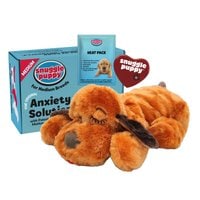
Snuggle Puppy heartbeat toy
Comfort toyThe original Snuggle Puppy has a battery-powered heartbeat for settling time. It is a comfort toy, not a chew toy: supervise use and remove it if your puppy starts chewing it. It does not replace your presence or a consistent routine.
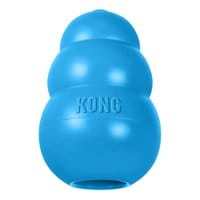
KONG Puppy toy
Puppy rubberSoft puppy rubber for supervised chewing and food-stuffed enrichment. This listing starts with Small; choose the size for your puppy using KONG's guide. Check for damage, replace when worn, and move up a size as your puppy grows.
Day-by-day schedule: days 1 through 7
Every puppy is different, but having a loose structure helps both of you. Here's a realistic framework for the first week. Don't treat this as rigid — treat it as a guide that flexes around your puppy's energy and temperament.
| Day | Morning | Afternoon | Evening | Notes |
|---|---|---|---|---|
| Day 1 | Arrive home, explore one room, first potty trip | Quiet time, naps, gentle handling | First crate session, calm evening routine | Keep it quiet — no visitors, no big adventures |
| Day 2 | Start feeding schedule, potty after every meal | Introduce crate with door open, feed inside | Begin bedtime routine: potty, crate, settle | Puppy may still be subdued — totally normal |
| Day 3 | Consistent potty schedule every 1-2 hrs | Short supervised exploration of another room | Practice crate door closed for 5-10 min | Most puppies start showing personality today |
| Day 4 | Continue routine, introduce basic name recognition | Gentle play sessions with rest between | Slightly longer crate sessions during day | Appetite usually returns to normal |
| Day 5 | Routine solidifying, potty trips more predictable | Short yard exploration (own yard only) | Evening play, then calm crate time | You should be seeing a rhythm forming |
| Day 6 | Puppy may start signaling for potty (going to door) | Introduce one new safe experience | Practice handling: paws, ears, mouth | Start very short alone-time practice (2-3 min) |
| Day 7 | Full routine day — puppy knows the drill | Socialization: calm visitor or new surface | Review the week, adjust schedule as needed | You survived — and so did they |
The most important pattern in this schedule is consistency. Puppies thrive on predictability. Same potty spot, same feeding times, same bedtime routine. The more consistent you are in week one, the faster your puppy learns what to expect — and a puppy who knows what to expect is a puppy who feels safe.
Crate training basics
A crate is not a cage — it's a den. Dogs are denning animals, and when crate training is done correctly, your puppy will seek out their crate as a place of comfort and security. Research from veterinary behaviorists consistently shows that crate-trained dogs have lower rates of separation anxiety, fewer destructive behaviors, and faster house training compared to dogs who are given free roam too early.
Never use the crate as punishment. This is the single most important rule of crate training. If the crate ever becomes associated with being in trouble, you lose all its benefits. The crate should only ever predict good things: meals, chew toys, naps, and calm downtime.
Feed every meal inside the crate. This is the fastest way to build a positive association. Place the food bowl at the back of the crate so your puppy walks all the way in. For the first few days, leave the door open while they eat. Then start closing the door during meals, opening it as soon as they finish. Gradually extend the time after meals before opening the door.
Build duration slowly. Start with 5 minutes with the door closed while you sit nearby. Then 10 minutes. Then 15 minutes while you move to another room. Then 30 minutes. Never jump from 5 minutes to 2 hours — that's how you create a puppy who panics in the crate. Progress should feel boring and easy to your puppy.
Respect age-based time limits. A young puppy's bladder and emotional tolerance have real limits. As a guideline:
- 8 weeks old — 2 hours maximum during the day
- 10 weeks old — 2.5 hours maximum during the day
- 12 weeks old — 3 hours maximum during the day
- 16 weeks old — 4 hours maximum during the day
Nighttime is different — puppies can hold it longer while sleeping because their metabolism slows down. Most 8-week-old puppies can make it 4 to 5 hours at night, extending to 6 to 7 hours by 12 weeks.
If your puppy is crying in the crate and you're sure they don't need to potty, wait for a break in the crying — even a 2-second pause — before opening the door. This teaches them that quiet gets rewarded, not noise. It takes patience, but it works.
House training fundamentals
House training is not about correcting mistakes — it's about preventing them. Every successful trip outside is a deposit in the training bank. Every accident inside (that you didn't catch in time) is a missed opportunity. The math is simple: maximize outdoor successes, minimize indoor accidents, and you'll have a house-trained puppy faster than you thought possible.
The potty schedule. Take your puppy outside to the designated potty spot:
- Immediately after waking up (every nap, every morning)
- Within 5 minutes of eating or drinking
- After every play session
- Every 1 to 2 hours in between
- Last thing before bed, first thing in the morning
Same spot every time. Walk your puppy to the same area on leash, stand still, and let them sniff around. Don't talk to them, don't play — this is business time. Most puppies will go within 3 to 5 minutes if they actually need to. If they don't go after 5 minutes, bring them back inside, crate them for 15 minutes, and try again.
Praise immediately. The instant your puppy finishes eliminating outside, give quiet, warm praise and a small treat. The reward has to happen within 1 to 2 seconds of the behavior — not when you get back inside. Timing is everything. Your puppy needs to connect "going potty in this spot" with "good things happen."
Clean accidents with enzymatic cleaner. Regular soap and water don't eliminate the scent molecules that your puppy can still smell. If the spot smells like a bathroom to your puppy, they'll use it as one again. Enzymatic cleaners break down the proteins in urine and feces completely. Saturate the spot and let it air dry.
Feeding during the transition
Your puppy's digestive system is sensitive, and stress alone can cause soft stool and reduced appetite during the first few days. Adding a sudden food change on top of that is asking for trouble. This is why responsible breeders include a bag of the puppy's current food in their go-home packet.
Stick with the breeder's food for 7 to 10 days. Even if you plan to switch to a different brand or formula, now is not the time. Let your puppy settle into their new environment first. Once their stool is firm and their appetite is consistent — usually by the end of the first week — begin a gradual transition.
The transition schedule below prevents most digestive issues. Rushing this process is the number one cause of diarrhea in newly homed puppies.
| Day | Old Food | New Food | Notes |
|---|---|---|---|
| Days 1-3 | 100% | 0% | Feed only the breeder's food — let the stomach settle |
| Days 4-5 | 75% | 25% | Mix in a small amount of the new food |
| Days 6-7 | 50% | 50% | Equal parts — watch stool consistency |
| Days 8-9 | 25% | 75% | Mostly new food now — stools should remain firm |
| Day 10+ | 0% | 100% | Fully transitioned to the new food |
Standard veterinary recommendation for puppy food transitions
Meal frequency and amounts. At 8 weeks, most puppies eat 3 to 4 meals per day. Follow the portion sizes your breeder recommended, and adjust based on your puppy's body condition. If you're unsure how much to feed, the food calorie calculator can help you dial in the right amount based on your puppy's breed, age, and weight.
Feed on a schedule — not free-feeding. Put the bowl down for 15 minutes, then remove it whether the puppy has finished or not. Scheduled feeding makes potty training dramatically easier (predictable input means predictable output) and helps you notice appetite changes quickly, which is one of the earliest signs of illness in young puppies.
For more on puppy nutrition fundamentals and how food transitions work from the breeder's side, see our guide on how to wean puppies.
What's normal versus what needs a vet call
New puppy owners worry about everything, and that's understandable. Here's how to tell the difference between normal adjustment behavior and genuine red flags that warrant a call to your veterinarian.
Normal adjustment behaviors include reduced appetite on the first day or two, soft stool for 24 to 48 hours (especially if there's any food variation), crying and whining at night for the first few nights, sleeping 18 to 20 hours per day (puppies need enormous amounts of sleep), and cautious or shy behavior in the new environment. These typically resolve on their own within 3 to 5 days as the puppy settles in.
Veterinary red flags include refusal to eat anything for more than 24 hours, repeated vomiting, bloody or black stool, extreme lethargy that goes beyond normal puppy sleepiness (the puppy seems limp, won't respond to gentle stimulation, won't stand up to eat), discharge from the eyes or nose, persistent diarrhea lasting more than 24 hours, straining to urinate or defecate, a swollen or hard abdomen, or any coughing, sneezing, or labored breathing.
Use the food safety checker to verify that nothing your puppy may have gotten into is toxic, and the puppy care schedule to stay on track with upcoming veterinary appointments.
The "puppy blues" are real
Here's something nobody tells you before you bring a puppy home: it is completely normal to feel overwhelmed, regretful, anxious, or even sad during the first week. There is a name for this — the "puppy blues" — and it's far more common than most people admit.
Research from veterinary behaviorists and surveys of new dog owners consistently show that the majority of people experience some degree of post-adoption stress. You're not sleeping well. The puppy is crying. There are accidents on the floor. You're questioning whether you made the right decision. This does not mean you made a mistake — it means you're going through an adjustment, just like your puppy is.
The puppy blues peak around days 3 to 5 and usually begin to fade by the end of the second week. By week 3, most owners report feeling bonded, confident, and genuinely delighted with their new companion. The turning point is almost always the first time your puppy does something that makes you laugh, looks at you with total trust, or falls asleep in your lap.
Here's what helps:
- Lower your expectations. Your puppy will have accidents. They will chew something they shouldn't. They will cry at 3 AM. This is normal, not failure.
- Take breaks. Crate the puppy for a nap (they need them!) and do something for yourself. Eat a meal, take a shower, sit in silence for ten minutes. You cannot pour from an empty cup.
- Talk to someone. Your breeder has heard this before. Friends with dogs have been through it. Online communities are full of people who felt exactly the same way. You are not alone.
- Focus on small wins. The first successful potty trip outside. The first night with only one wake-up. The first time the puppy walks into the crate voluntarily. These small moments are the building blocks.
- Remember why you did this. Revisit the excitement you felt before pickup day. Look at photos. Think about the years of companionship ahead. The hard part is temporary — the good part lasts a lifetime.
If your feelings of anxiety or regret intensify instead of improving after the first two weeks, or if you're experiencing symptoms of depression, please reach out to a healthcare professional. Post-adoption depression is a recognized phenomenon and there is no shame in asking for support.
Setting up for week 2 and beyond
By the end of the first week, you should have a loose daily routine in place, your puppy should be eating normally, crate training should be underway, and you should be seeing the beginnings of a potty training pattern. The hard part is over. Week 2 is when things start getting fun.
Start thinking about:
- Socialization — The critical socialization window runs until about 16 weeks. Begin safe, positive introductions to new people, surfaces, sounds, and experiences. Read our socialization protocol for structured guidance.
- Basic training — At 8 to 9 weeks, your puppy can start learning their name, "sit," and "come." Keep sessions to 2 to 3 minutes and always end on a success.
- Vaccination schedule — Your puppy will need additional rounds of core vaccines. Check with your vet and use the puppy care schedule to track upcoming dates.
- Fear periods — Puppies go through developmental fear periods where they may suddenly seem afraid of things they were fine with before. Understanding these periods prevents you from accidentally making fears worse.
The first week is about survival and trust-building. Everything else — the training, the socialization, the adventures — builds on the foundation you lay in these seven days. Be patient, be consistent, and trust the process. You and your puppy are going to be just fine.
First week FAQs
How long will my puppy cry the first night?
When can I take my puppy outside?
How often should an 8-week-old puppy go out to potty?
Is it normal for my puppy not to eat the first day?
Should I let my puppy sleep in my bed?
When will my puppy be house trained?
My puppy seems scared of everything — is this normal?
Sources and further reading: American Veterinary Society of Animal Behavior (AVSAB) position statement on puppy socialization; Dr. Ian Dunbar, Before and After Getting Your Puppy; veterinary behaviorist research on crate training effectiveness and welfare outcomes; AVSAB position statement on the use of punishment for behavior modification in animals; studies on enzymatic vs. standard cleaning agents for house training success rates.
Related Tools
Sources: AVMA new owner and puppy care resources; ASPCA puppy transition and adjustment resources; AKC S.T.A.R. Puppy program and AKC new owner guides; AAHA Canine Life Stage Guidelines (2019). This article is for educational purposes and does not replace professional veterinary care.